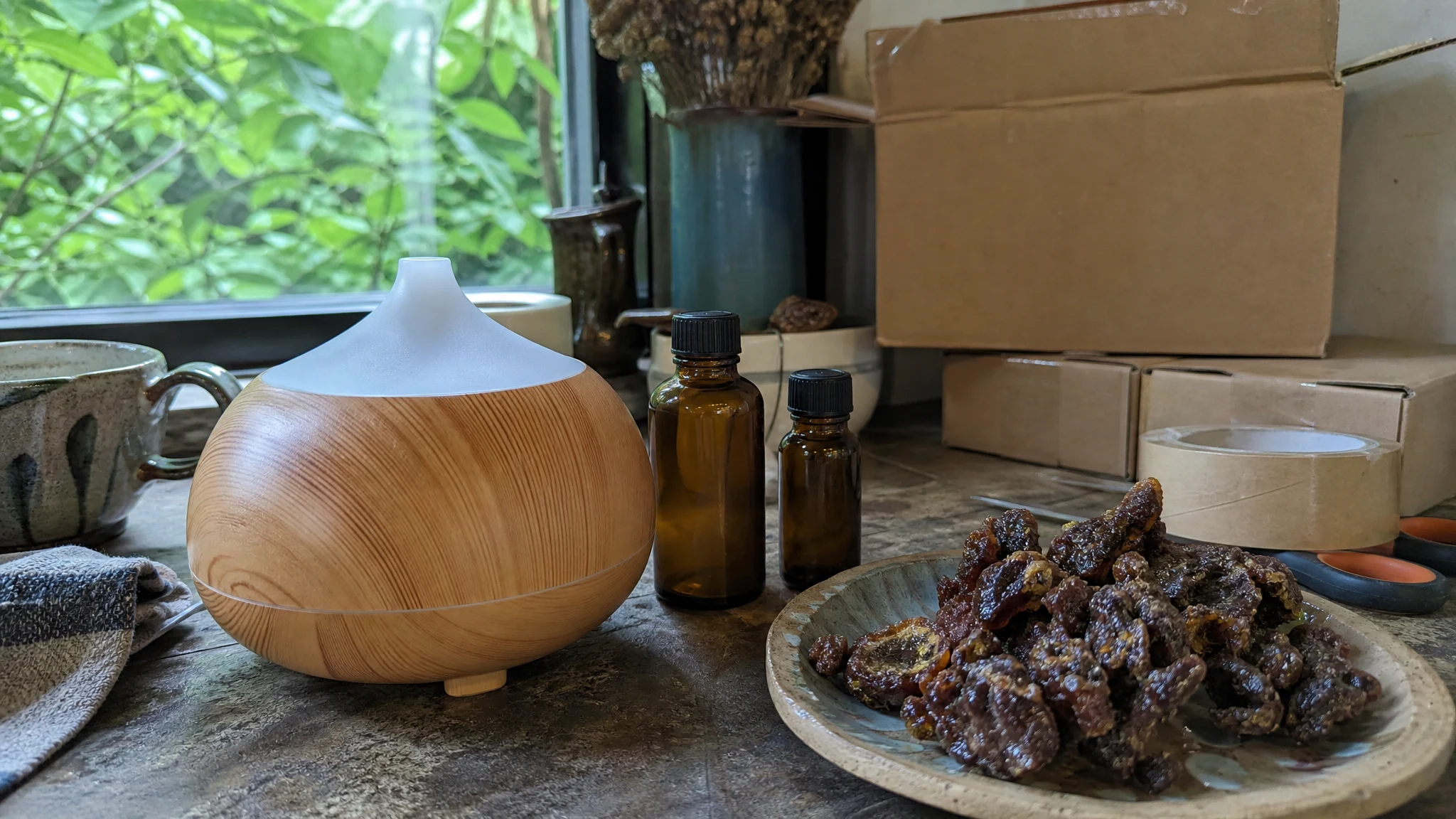
Labdanum Essential Oil Blends: Diffuser Recipes and Pairings
Some scents fill a room quickly and vanish. Labdanum is not one of them. This smoky, leathery, sweet oil settles in slowly and stays for hours, which makes it a favorite base note for home blending. This guide walks you through three diffuser recipes, the pairings that suit it best, and the safety basics to follow every time you use it.
Difficulty: Easy
Prep time: 5 minutes per recipe (15 minutes if you make the stock blend)
Yield: One diffuser session, or one 10 ml stock bottle
Meet Labdanum Essential Oil
Labdanum Essential Oil comes from Cistus ladanifer, also called rockrose. This low shrub grows across the rocky, sun-exposed slopes of the Mediterranean region. In summer heat, its narrow leaves and twigs exude a dark, fragrant gum. That gum is collected and steam-distilled, which pulls the aromatic oil free from the resin.
The result is a viscous, amber-toned liquid. Its aroma is rich and smoky-sweet, with hints of leather, dried fruit and warm wood. It is thicker than most essential oils, and that matters at the bench. Expect slow drips, and give the bottle a moment.
Perfumers use it as a long-lasting base note because it anchors lighter top notes and keeps a fragrance present for hours. A few drops warmed in a diffuser give a room a slow, amber-toned background scent.
Best Pairings for Cistus ladanifer
Labdanum combines readily with several classic ingredients. Each one shifts the mood in a different direction.
| Pairing | What it brings to the blend |
|---|---|
| Sandalwood | A soft, resinous depth with a creamy woody backdrop |
| Oakmoss | An earthy, deep character that suits a forest-floor mood |
| Vanilla | Extra sweetness that rounds off the smoky edges |
| Frankincense | A resinous layer that makes the blend feel ceremonial |
Ingredients and Equipment
- Labdanum Essential Oil, 3 to 4 drops per session
- Sandalwood essential oil, 2 to 4 drops
- Frankincense essential oil, 2 to 3 drops
- Vanilla (a vanilla-scented oil or absolute from a trusted source), 1 to 2 drops
- Oakmoss (a trusted oakmoss-scented ingredient), 1 drop
- Water for your diffuser, filled to the line in the manual
- Ultrasonic diffuser (100 ml water capacity is assumed below)
- Optional for the stock blend: 10 ml amber glass bottle with a dropper cap
Three Diffuser Recipes
1. Amber Evening
A warm, woody scent for a quiet bedtime wind-down.
- 3 drops Labdanum Essential Oil
- 4 drops sandalwood
- 2 drops frankincense
2. Sweet Resin
A rounder, dessert-like blend for cozy afternoons.
- 3 drops Labdanum Essential Oil
- 2 drops vanilla
- 3 drops sandalwood
3. Forest Floor
Earthy and deep, with a smoky edge that suits rainy days.
- 4 drops Labdanum Essential Oil
- 1 drop oakmoss
- 3 drops frankincense
Step-by-Step Instructions
- Prepare your diffuser. Clean it and fill it with fresh water to the marked line.
- Warm the labdanum. Hold the closed bottle in your palm for a minute. The oil is thick, and warming it helps it flow.
- Add the labdanum first. Because it is viscous, add it first and give the dropper time to release each drop. Count slowly.
- Add the lighter oils. Add the remaining oils from your chosen recipe.
- Swirl gently. Stir the water once with a clean toothpick so the oils begin to combine.
- Run the diffuser. Use the intermittent setting if your model has one, for 30 to 60 minutes at a time, in a ventilated room.
- Rinse afterward. Wipe the diffuser with a soft cloth and a little rubbing alcohol. Thick oils can leave a film.
Stock blend option: To save time, combine the drops from one recipe in a 10 ml amber bottle, multiplying by five. Shake gently, label it with the date, and use about 8 to 10 drops of the blend per diffuser session.
Safety Warnings
- Dilution: Never apply undiluted essential oil to the skin. For the topical variations below, keep the dilution at about 1 percent, which is roughly 6 drops per 1 fluid ounce (30 ml) of unscented carrier.
- Patch test: Mix a small amount at your intended dilution, apply a dab to the inner forearm, cover it, and wait 24 hours. Stop use if you notice redness or irritation.
- Ventilation: Diffuse in short sessions with fresh air in the room. Never leave a diffuser running unattended for long periods.
- Who should check first: If you are pregnant, nursing, taking any medication, or under a doctor's care, consult a qualified medical professional before using essential oils.
- Children and pets: Keep oils out of reach. Some animals are sensitive to diffused oils, so give pets a way to leave the room.
- Internal use: Do not swallow essential oils. Keep them away from eyes.
- Not a substitute for care: Essential oils are for aroma and atmosphere. Never stop or replace anything your doctor has advised.
Variations and Substitutions
- Lighter version: Reduce labdanum to 2 drops and add a bright top note, since labdanum anchors lighter oils so well.
- Swap the wood: If sandalwood is not available, use another warm woody oil you enjoy, then adjust by nose.
- Linen spray: In a 2 fl oz (60 ml) glass spray bottle, dissolve 8 drops of labdanum blend in 1 tablespoon of high-proof unscented alcohol, then add distilled water. Shake before each use and spray on fabric only, after testing a hidden spot.
- Lotion base: Stir up to 6 drops of blend into 1 fluid ounce of unscented lotion for a subtle, lasting warmth. Patch test first.
- Candles and soap: Crafters often mix labdanum into woody or spiced formulas for added richness. Follow the usage rates for your specific wax or soap base.
Storage and Shelf Life
Keep Labdanum Essential Oil in a dark glass bottle with the cap tightly closed. Store it somewhere cool and away from direct sunlight and heat. Because the oil is thick, wipe the bottle neck after each use so the cap does not stick.
Essential oils generally keep their best aroma for a few years when stored well. For blends, a good rule of thumb is to use them within about six months. Trust your nose: if the scent turns sharp or flat, replace the blend. Label every bottle with the date you made it.
Final Notes
Start small with labdanum, since a little goes a long way. Adjust one drop at a time until the room feels right. When you are ready to try it yourself, browse the Labdanum Essential Oil collection, or head back to our home page for more blending ideas.